Limitless

From visibility to credibility: how PR wins where ads can’t

Anyone can purchase ads to get views and clicks. And a clever ad campaign, with a decent budget, can make sure your brand is launched into the digital sphere and win you clicks. But what comes after the click? How confident does the customer feel they have arrived in the right place? Is yours a brand they already know and trust?  You’ve won the click, but are have they got the confidence to actually buy, if this is the first they have heard of you. Or would they be wise to shop around a little more first?

This is where PR enters the picture. Public relations doesn’t just share your message: it builds credibility, strengthens reputation, and ensures your brand’s voice lands with the right people at the right time – usually before they even arrive at your website with a mind to buy.

Businesses that underestimate the power in PR risk spending cash on clicks but still losing customers to competitors who have invested in brand as well as click bids.

Limits of paid media?

Paid ads are great for grabbing attention, and fast. But attention on its own isn’t enough. You need more. As the generation of social media consumers, we endlessly – and mindlessly – scroll past ads and content, and then it’s gone. Research shows that audiences are increasingly sceptical of paid messages, with a quarter of the public actively distrusting ads. Spending big budgets on ads doesn’t guarantee lasting influence. Ads can deliver reach, but reach without trust is just noise.

What PR does differently

PR is earned, not bought. Coverage in newspapers, magazines, podcasts, and credible online outlets carries weight because it comes from a third party. People choose to engage with it. They read the story, digest the context, and most importantly, they trust the source.

Beyond trust, PR creates depth of engagement. A feature article, an expert quote, or a well-timed press release gives your audience a reason to think and connect with your brand. This is the opposite of the doomscroll – it’s attention that lasts.

In today’s rapidly travelling digital sphere, earned media doesn’t just reach humans. AI-powered search engines rely on reputable journalism to generate credible content. Your brand’s credibility goes beyond surface visuals, with AI shaping how content is discovered by algorithms in ways that ads can’t.

PR in action

In the UK, national news brands reach around 24 million adults daily. That’s comparable with major broadcast channels. While fewer people may pick up a newspaper than say a decade ago, those who do are giving more time and attention than a quick social scroll ever demands.

Small businesses and big brands alike have leveraged PR to punch above their weight, earning coverage that increases awareness, positions them as experts, and drives real engagement, all without the huge cost of paid ad campaigns.

Why do businesses still underinvest?

Despite the many advantages, many smaller companies underinvest in PR and wonder what’s hindering their growth. Reasons for this range from cost, measuring concerns, and the reliance on ads. But strategic PR is measurable.

Final thoughts

Visibility is cheap, but credibility is priceless. PR converts exposure into trust, influence, and authority that turbocharge ad performance along with all marketing channels.

For businesses serious about growth, investing in PR isn’t optional. It’s a strategic move that boosts sales and supports long term growth.

Want to find out more? Drop Michael Gregory a message and see how we can work together to help your business grow

New Chair for Lancaster University’s Engineering Industry Advisory Board

Lancaster University’s School of Engineering has appointed Andy Davy as the new Chair for its Industry Advisory Board.

The Industry Advisory Board (IAB) brings together employers and professional bodies to advise on teaching and research priorities, feed skills needs into curriculum planning, and support student placements and internships. It also provides external input to accreditation and wider engagement activity, helping ensure graduates’ capabilities match sector demand and creating clear routes for companies, including SMEs, to collaborate with the School.

A long-standing member of the board, Andy Davy is Group Operations Manager at Lancaster-based Like Technologies, which provides specialist electronic and control-system support to clients across the nuclear and advanced engineering sectors, including obsolescence management and equipment repair.

In his role as Chair, Andy will lead twice-yearly IAB meetings and work with the IAB co-ordinator, Chris Lambert to agree agendas and formats. He will also review minutes and represent the board at formal engagements such as accreditation visits.

On his appointment as Chair, he said: “Chairing the board is about turning employer insight into practical outcomes. Feeding into the curriculum, helping to ensure the teaching provides the students with the knowledge, skills and behaviours that add value for local firms. That two-way flow helps students hit the ground running and gives businesses a straightforward route into the School when they need skills or fresh ideas.” 

Chris Lambert, Director of Engagement, School of Engineering, Lancaster University, said: “We very much welcome Andy as Chair of the board. His deep, front-line, industry experience and knowledge will help guide the board in its role as a sounding-board for curriculum relevance, accreditation and employability. Its members’ perspectives shape modules, open up internships and placement year roles, and guide where our engagement will have most impact.”

Trident Utilities appoints new head of procurement 

Blackpool-based energy consultancy Trident Utilities has strengthened its leadership team as the business positions itself for its next phase of growth. 

As part of the changes, Alexandra Mottershead has been promoted to Head of Procurement & Supplier Services. Alex joined Trident in March 2022, at the height of the energy crisis, bringing a decade of experience in the energy consultancy sector. 

After graduating from the University of Manchester with a degree in Atmospheric Physics, Alex joined the industry as a fixed procurement analyst and has since built extensive expertise across risk management, trading, procurement, and supplier relations. 

Trident Utilities

In her new role, Alex will lead Trident’s risk management, trading, procurement, and supplier services functions. Her team is responsible for strategically procuring energy for customers by balancing individual organisational priorities and risks with market opportunities and net-zero objectives.  

This includes managing both fixed-term contracts and flexibly traded procurement strategies, as well as overseeing fixed and flexible Power Purchase Agreements (PPAs) for generators to maximise revenues while mitigating operational risk. 

Alex’s team also includes Trident’s non-commodity specialists, who provide vital updates to customers on charging, policy, and regulatory changes that may impact future energy costs. 

Alexandra Mottershead, head of procurement & supplier services, said: 

“I’m really proud to be stepping into this role at such an important moment for the energy sector.  

“My focus is on making sure organisations have the clarity and confidence they need to make informed energy decisions that support both commercial resilience and their journey to net zero. I’m also genuinely excited to be leading such a talented team as we continue to strengthen our procurement and risk management capabilities.” 

Andy Curry, head of client services, added: “Everything we do at Trident is grounded in strong data and sound science, and Alex brings a rare combination of both. Her deep understanding of the science, alongside more than a decade of hands-on industry experience, is invaluable for our clients and adds real strength to our wider leadership team. 

“Alex’s perspective will further strengthen our ability to help clients make informed, long-term strategic decisions as they seek to lock in energy efficiencies and cost savings on the path to net zero.” 

A beginner’s guide to earned media

Earned media (or PR and media relations, as it’s more traditionally known) is back in fashion. Big-time.

As AI-powered search and discovery systems increasingly prioritise authority, credibility and third-party validation, organisations are rediscovering something the media industry has always known: independent coverage carries weight. Not just with people, but with the new machines that feed them their intel.

This renewed interest in earned media credibility has brought a wave of newcomers into PR – founders, marketers and brand teams who suddenly need credible off-site coverage, but have never worked with journalists before. Many arrive with assumptions shaped by social media and self-publishing. And those assumptions, left unchallenged, are where things can go wrong. Sometimes, very wrong.

The new era for an old mental model

If you’ve built your reputation through social platforms, content marketing or founder-led channels, the world of journalistic PR can come with some surprises.

Social media trains people to think in terms of speed, volume and control. You publish when you like. You adjust if something lands badly. You delete if it doesn’t. The feedback loop is instant, and the consequences are usually contained.

Earned media operates on a different set of values entirely.

You don’t own the platform. You don’t control the final output. You have no direct control over whether your story gets published at all. And once something is published, it exists – often permanently – outside your control.

For many first-timers, that inversion of power comes as a shock.

Earned media is not “content”

It helps to be precise about terms.

  • Owned media is what you publish yourself: your website, blog, newsletter.
  • Shared (i.e. social) media is rented space: governed by platform norms, algorithms and fleeting attention.
  • Earned media is coverage you do not control, created by people whose job is not to serve your brand.
  • Paid media is when you realise there can be a chequebook requirement to staying in absolute control of what others publish about you.

Many marketers have grown up in an environment where owned and shared media were all that mattered.

While paid media is almost a separate animal entirely, earned media is where the value is in the world of LLMs. And it derives its value from independence. If journalists simply echoed brand messaging, their work would be worthless to readers, and increasingly to AI systems trained to discount self-interested sources.

This is why earned media can feel uncomfortable to newcomers. Credibility comes precisely from the fact that scrutiny – sometimes aggressive – is built in.

Journalists are not marketers – and never will be

One of the most common mistakes newcomers make is assuming journalists care about marketing goals. They don’t.

Journalists care about:

  • What’s new
  • What’s true
  • What’s relevant
  • What matters to their audience

They are not interested in your funnel, your positioning statement or your quarterly targets. They are trained to interrogate claims, not amplify them.

This isn’t hostility. It’s professionalism.

Journalism is a vocation. It comes with norms, ethics and responsibilities that sit apart from brand building. Respecting that is not optional.

When PR works well, it’s because it understands this distinction and works with it, not against it.

The risks of “playing journalist”

In recent years, the lines between journalism, content and personal branding have blurred, sometimes unhelpfully.

High-profile “content platforms” that mimic journalistic formats without adopting journalistic discipline have shown what happens when editorial challenge is replaced by brand alignment. Interviews become vehicles for self-promotion. Claims go unchecked. Extremes attract attention precisely because nothing pushes back.

When self-promotional content creators (the types that like using the term CEO a lot for instance) come under scrutiny, it’s rarely about intent. It’s about structure. Journalism without independence, verification or accountability isn’t journalism. No matter how polished a podcast studio looks, shine without responsibility can come at a cost.

This matters for anyone entering earned media from a content background. The goal is not to perform journalism. It’s to engage with professionals who practice it properly.

PR is a grown-up discipline, and that shows in the process

Beyond philosophy, there are practical realities of earned media that often catch social-media natives off guard.

The first is permanence.

You can’t quietly edit a press release once it’s sent. You can’t retroactively clarify a quote once it’s published. Corrections, if they happen at all, are visible, and often draw more attention than the original error.

Which brings us to the second shock for many: APPROVALS. Written in caps for a reason so you don’t miss it.

In earned media, nothing should be issued without:

  • Fact-checking
  • Verification
  • Internal sign-off from EVERYONE with reputational exposure

This can feel painfully slow to people used to publishing on instinct. But it exists for a reason. When the consequences are external and long-lasting, diligence matters more than speed.

And then there’s the highest bar of all: EDITORIAL INTEREST.

Also written in caps for good reason.

Journalists are not short of material. If what you’re offering isn’t genuinely interesting, original or insightful, it simply doesn’t get published. There is no courtesy reach. No participation trophy. No algorithm to game.

This is a hard adjustment for those accustomed to self-publishing. In the real media, your content is judged before its published. If it doesn’t pass the interest test, it just doesn’t run.

Newcomer basics

If you’re new to earned media, a few fundamentals will save you time and trouble:

  • Earned media isn’t content. It’s actual news.
  • Journalists aren’t interested in marketing. They’re professionals with a genuine obligation to inform.
  • Credibility comes from the very fact you are not in control.
  • The approval process exists because mistakes have an impact.
  • If something isn’t genuinely interesting (to someone else), it won’t be published.

Earned media hasn’t come back into fashion because it’s easy. It has come back because, in a crowded and automated information environment, trust still has to be earned.

What is earned media?
Coverage secured through editorial merit rather than paid placement.

Why is earned media important?
It increases trust, improves search rankings via backlinks, and enhances brand authority.

What counts as earned media?
Press coverage, expert commentary, reviews, interviews, features, and organic online mentions.

Public relations, your business and what’s in store for 2026

As we reach the end of 2025, we’re looking ahead to how public relations can support and strengthen your business. With AI rapidly transforming the landscape of communication, customer expectations, and reputation management, it’s fair to say that 2026 will bring a wave of new opportunities – as well as fresh challenges – that make strategic public relations more valuable than ever.

Here are five things worth keeping on your radar for the year ahead.

1. AI is a driver

AI is changing fast, and it’s not just about being able to use the technology; more about how to clearly explain it. Businesses will need PR teams who understand AI and can turn complex tech into simple, confident messages that their audiences can be reached with and understand.

With the rapid development of artificial intelligence – Generative Engine Optimisation (GEO) – is emerging. Instead of delivering lists of clickable links as search engines have previously done, AI-powered search tools now provide summaries based on information from various sources and may include generated perspectives. This will be a key feature in the coming year, as we’ve previously talked about.

2. Reputation will be harder to protect and easier to lose

With deepfakes, misinformation, and rising public scepticism, trust is absolutely fragile. Mike Robb, Co-CEO of Boldspace, said:

“Trust will (still) be the hardest currency to earn. With audiences increasingly sceptical of everything they see and hear, brands can’t rely on polished messaging alone.”

PR should focus on building credibility through actions, evidence, and consistency. Through strategic communications, you can show your values and impact, while keep your brand’s messaging authentic.

3. Earned PR goes beyond traditional media, into creator and community space

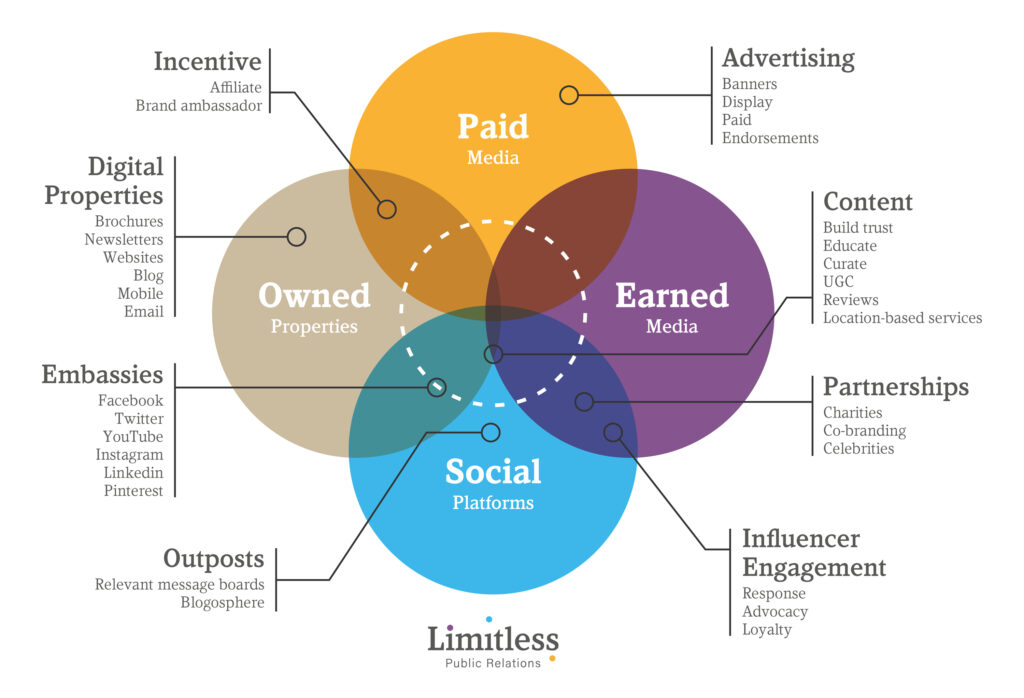
The PESO Model (Paid, Earned, Shared, Owned) remains at the centre of modern communications strategies. Earned media now includes so much more than only traditional press – individual creators, community forums, industry voices, podcasts, Substack writers, and specialist online communities – not just newspapers and broadcast media. Credible publication sources will feed into GEO, enhancing public relations results.

4. Purpose-driven communications take priority 

Audiences are increasingly looking beyond products and services to what a business stands for. Social responsibility, sustainability, diversity, ethical practices… all are part of how your brand is judged. Taking a stand and showcasing your purpose – authentically – is a powerful position. Public relations can help you to craft your values-led messaging, helping a positive reputation and stakeholder trust to grow.

5. Crisis readiness will be a core part of business

Today’s fast-moving information landscape means problems can spiral quickly and cause serious damage. Strategic communications helps you to stay prepared; from planning for potential scenarios and spotting misinformation early, to having systems in place for rapid response to a real crisis. In 2026, being ready won’t just protect your reputation – it will save time, resources, and stress when things go wrong.

Considering an overhaul in your strategic communications in 2026? We can help. Drop us a message here to find out how we create strategic, powerful communications that land – and last.

BAKO named ‘Supplier of the Year’ at awards

Preston-based BAKO, has been named Supplier of the Year at the prestigious 2025 Baking Industry Awards, at the Royal Lancaster in London.

Now in their 38th year, the Baking Industry Awards are the UK’s foremost celebration of excellence across the baking sector, from artisan bakers and large-scale manufacturers to suppliers, retailers, and innovators.

This year’s event welcomed more than 600 guests from across the industry for an evening honouring the best and brightest in British baking.

BAKO took home the inaugural Supplier of the Year title, with judges praising the company’s unwavering commitment to serving the baking community, significant business growth, and strategic innovation.

BAKO’s recent acquisition of Finlay’s Foods, expanding its reach across the UK and Ireland, was highlighted as a major step forward, alongside its sustained investment in operational efficiency, sustainability initiatives, and industry development.

Mike Tully, chief executive of BAKO said:

“This award is a tremendous honour and a reflection of the dedication of our teams across the UK and Ireland.

“At BAKO, everything we do is guided by our ‘by bakers for bakers’ ethos. We’re proud to support the industry we love, from local independents to national brands, with quality, service, and innovation.

“Winning Supplier of the Year at such a respected event reinforces our belief that partnership and passion truly make a difference.”

Amy North, British Baker editor, said:

“BAKO is a worthy winner of British Baker’s first-ever Supplier of the Year trophy at the Baking Industry Awards.

“Its longstanding commitment to and influential role within the baking industry deserves recognition, and our panel of judges praised the level of energy put into every aspect of the business from investments in efficiency to supporting the future of the industry, and steps on its sustainability journey.

“BAKO truly is living up to its motto of ‘by bakers for bakers.”

Founded over 60 years ago, BAKO operates from its head office in Preston, with regional headquarters in Durham, Wimbledon, and Ireland, allowing it to provide nationwide coverage and local expertise to bakeries of all sizes.

The business has grown to become one of the UK and Ireland’s leading bakery ingredient and supply specialists, offering an extensive range of products and services designed to help the baking industry thrive.

The Baking Industry Awards are organised by British Baker magazine and celebrate excellence across 14 categories, recognising individuals, teams, and businesses driving the sector forward.

For more information about Bako, visit www.bako.co.uk

Lancaster man releases sleep science inspired children’s book

A Lancaster man has published a bedtime storybook based on the latest sleep science, with the aim of helping tired parents get young children off to sleep.

Greg Wilson, a public relations consultant based in Lancaster, was first inspired to write the book fifteen years ago while reading with his own young children at night. The idea came to him after noticing, when his children yawned, it should be the last book, as they were ready for sleep.

After reading a newspaper article that suggested that contagious yawning itself triggers sleepiness, he then developed The Biggest Yawn of All with Preston-based illustrator Kath Walker, as a fun way to encourage yawning at bedtime.

After shopping the book around a number of publishing agents, the feedback was that the original plan to end the book with a mirror would be too expensive a risk for a first time author with traditional publishing.

And so the project was shelved until this year, when Mr Wilson read a new article on the same subject that seemed to confirm the theory of contagious yawning being a cause rather than an effect of sleepiness, and decided to try publishing the book directly with Amazon.

He says: “I always really enjoyed reading to my own kids at bedtime but there was still a small sense of relief after three or four books when they would do a little yawn, which was a signal it was time to wind things up and put out the light.

“So, when I read that yawning – and contagious yawning in particular – actually works as a trigger for sleepiness, I wondered if that could be the basis for a fun book that could also work as a subtle sleep tonic for young children.

“After previously putting the idea on ice, I had almost forgotten about it until I read another article earlier this year about chimpanzees getting themselves ready for bed after picking up contagious yawns from a robo-chimp placed in their camp, confirming the theory that yawns actually make you sleepy.

“Amazon publishing wasn’t really a thing when we first developed the book, so I called Kath to check she was up for giving it a go publishing directly, this time with a different ending that is cheaper to print, but which still works as well, I think.

“We are initially targeting the UK and US markets with the English version of the book, and its success or failure is very much at the mercy of the Amazon algorithms.

“But if it takes off in those markets, the plan is to get it translated and try publishing it across the world, as a way of helping hardworking parents everywhere get their own little monkeys off to sleep at the end of the day.”

The Biggest Yawn of All is available from Amazon at https://amzn.eu/d/hQyfh7F.

The Harris Museum announces grand reopening this September

Preston’s iconic cultural landmark is set to welcome up to half a million visitors each year following a £19 million major restoration.

Made possible with funding from Preston City Council, The National Lottery Heritage Fund, the UK Government’s Towns Fund, Lancashire County Council and many other generous partners.

The Harris will officially reopen its doors to the public on Sunday, 28 September 2025 following a once-in-a-generation restoration as part of the Harris Your Place project. The transformation reimagines The Harris as a dynamic and inclusive cultural hub for the 21st century, blending art, history, community, and a refreshed library service to deliver an exciting new visitor experience.

Located in the heart of Preston, The Harris will relaunch with an impressive exhibition programme, learning spaces, family-friendly facilities, a new café and shop, and new heritage tours that celebrate its architectural and civic legacy. The reopening will mark a new chapter for one of the UK’s leading regional museums, libraries and galleries.

Councillor Anna Hindle, Cabinet Member for Culture and Arts at Preston City Council said:

“The reopening of The Harris marks a proud and exciting moment for the city of Preston. This incredible transformation will not only safeguard our heritage but also create a vibrant, inclusive space that inspires creativity, learning and connection for generations to come. We’re immensely grateful to all our funding partners and can’t wait to welcome residents and visitors alike back through the doors of this much-loved building.

“The Harris Your Place project has been made possible thanks to the generous support of key partners. We gratefully acknowledge Preston City Council, The National Lottery Heritage Fund, UK Government’s Towns Fund, Lancashire County Council and Arts Council England. Their vital contributions have helped preserve The Harris for future generations while strengthening access, learning and community engagement.”

John Chesworth, Chair of Preston’s Towns Fund Board, said:

“This much-anticipated and eagerly awaited new era for The Harris represents a major element of the ongoing regeneration and rejuvenation of Preston, alongside other landmark schemes such as the transformation of Amounderness House into managed workspace and the £45m flagship Animate entertainment and leisure destination, delivering economic growth and opportunities for all in a truly revitalised city centre.”

Helen Featherstone,Director, England, North at The National Lottery Heritage Fund, said:

“We are proud to be supporting the Harris Your Place project, thanks to money raised by National Lottery players. Working with Preston City Council, this exciting initiative will provide a sustainable home for the Museum’s collections, which will ensure that they are accessible for local communities and visitors to learn more about the city’s rich heritage.

“We know that heritage can play a huge role furthering a sense of pride in local communities which in turn can boost the local economy, and this project is sure to be a wonderful example of that.”

County Councillor Matthew Salter, Cabinet Member for Education and Skills, Lancashire County Council, said:

“We’re excited to see the Preston Harris Library reopening and back in this iconic building, which is such an important part of the community.

“That’s why we have contributed £1.375m towards the project and our refreshed library. This revitalised space will continue to house Preston’s biggest library and serve as a hub for learning and education for all residents. We can’t wait to welcome everyone back to this wonderful space.”

Closed since 2021, essential works have included the safe removal of asbestos from the roof, comprehensive repairs to preserve the building’s historic structure, and vital improvements to heating, lighting, and accessibility throughout the building. When it reopens, visitors can expect a fully reimagined experience, with new galleries, and community facilities.

Following the refurbishment of The Harris, annual visitors are expected to increase by approximately 100,000 on top of the existing 350,000 (in 2021).

Additionally, The Harris is unveiling a fresh new look including a redesigned logo, brand identity, and new website. The modernised branding aligns with the aims of the Harris Your Place project: inspired by community input and honouring the building’s heritage while looking confidently to the future.

More details about the reopening events, exhibitions and public programming will be announced in the coming weeks. For more information visit The Harris.

Don’t let your comms go quiet this summer

As the UK summer makes its entrance (hopefully!), it’s easy for SMEs to fall into a content-holding pattern: light seasonal posts, a few sunny team updates, and not much else.

But here’s the thing: if you want your communications to work hard for your business, even during quieter months, you need a plan. Strategic communications don’t take time off, and neither should your brand visibility.

Why summer is a hidden opportunity for SMEs

While others wind down, you can stand out. Fewer updates on people’s feeds means there’s potentially less competition and more chance for your content to cut through. Whether you’re building trust, showcasing your expertise, or strengthening your brand, now is the time to show up with purpose.

Here are three ways you can do it:

1. Use summer themes that have substance

Community events, wellbeing initiatives, flexible working…these are perfect seasonal content ideas. But don’t stop at surface-level content. Make sure you tell stories that align with your values and show how your business makes a real impact.

2. Keep your messaging consistent and clear

Your audience might be in a more casual browsing mode, but that doesn’t mean they don’t notice quality. Every post should reflect your brand voice and purpose. Clarity and consistency win –  even in flip-flop season.

3. Lean into thought leadership while others stay quiet

Summer is a brilliant time to share insight. Fewer voices mean your perspective carries more weight. Share a fresh take on your industry, highlight what you’re learning, or reflect on your growth. Be the expert your audience remembers. Great PR isn’t just about being seen: it’s about being remembered for the right things.

If you’re tired of shouting into the void, we can help. Drop us a message here to find out how we create strategic, powerful communications that land – and last.

Brightsolid and Synergi announce acquisition

Limitless Public Relations’ client, the cloud services company Brightsolid, has announced its full acquisition of Gateshead-based IT solutions provider Synergi.

Established over 25 years as part of DC Thomson, Brightsolid is a leading managed hybrid cloud and cyber security services provider, with customers including Aberdeenshire Council, Dumfries and Galloway Council, Dundee City Council, Shell, University of Dundee and West Yorkshire Combined Authority.

Founded in 2013 and having grown since to a team of 59, Synergi works in a wide range of sectors providing solutions including automation, modern intranet and teamwork solutions, cyber security, data & AI, business applications and devices, with clients including Princes, NHS Highland, Arriva, Lothian Buses and Scottish Fire & Rescue Service.

Following the acquisition, Synergi will continue to operate under its existing brand with no disruption to its customers or team.

Brightsolid CEO Elaine Maddison said: “Over the past year, Brightsolid has been actively looking for an organisation that can extend our range of services and support our growth plans across the UK. As a highly successful Microsoft Partner, Synergi does all of that, and more. The culture and people are a brilliant fit for Brightsolid and we anticipate growth opportunities for both brands going forwards.” 

Synergi cofounder and CEO Peter Joynson said: “Whilst we’ve been approached by buyers previously, we feel that the alignment and cultural fit Brightsolid provides make them a truly perfect match – a great bunch of positive, friendly and very smart people.

“Brightsolid specialises in cloud, colocation, cyber resilience and business continuity, so there are going to be lots of opportunities for us to work together to grow both companies, helping us meet our ongoing commitments to the business and our combined future success.”

For more information go to www.brightsolid.com or www.teamsynergi.co.uk.