Limitless

Young Bakers’ festive creations head for national launch with BAKO

BAKO has unveiled the results of its first Young Bakers initiative, a new collaboration with Coleg Cambria and Wrights Food Group designed to inspire the next generation of bakers.

The project has delivered three festive products: an Irish Coffee Slice layered with coffee caramel and an Irish liqueur cream, a Black Forest Slice reimagined for modern tastes, and a savoury chicken, brie and cranberry Festive Slice. All three will launch to customers from 1 September 2025.

A percentage of profits from the sales will be reinvested into a dedicated fund for future projects, ensuring the Young Bakers Initiative continues to support young talent year after year. The project is supported by the Craft Bakers Association & The Worshipful Company of Bakers

The idea for the initiative originated from discussions at Coleg Cambria about how to connect education more closely with industry. With BAKO and Wrights keen to support the next generation of bakers, the partnership came together quickly and provided the perfect platform to launch the project.

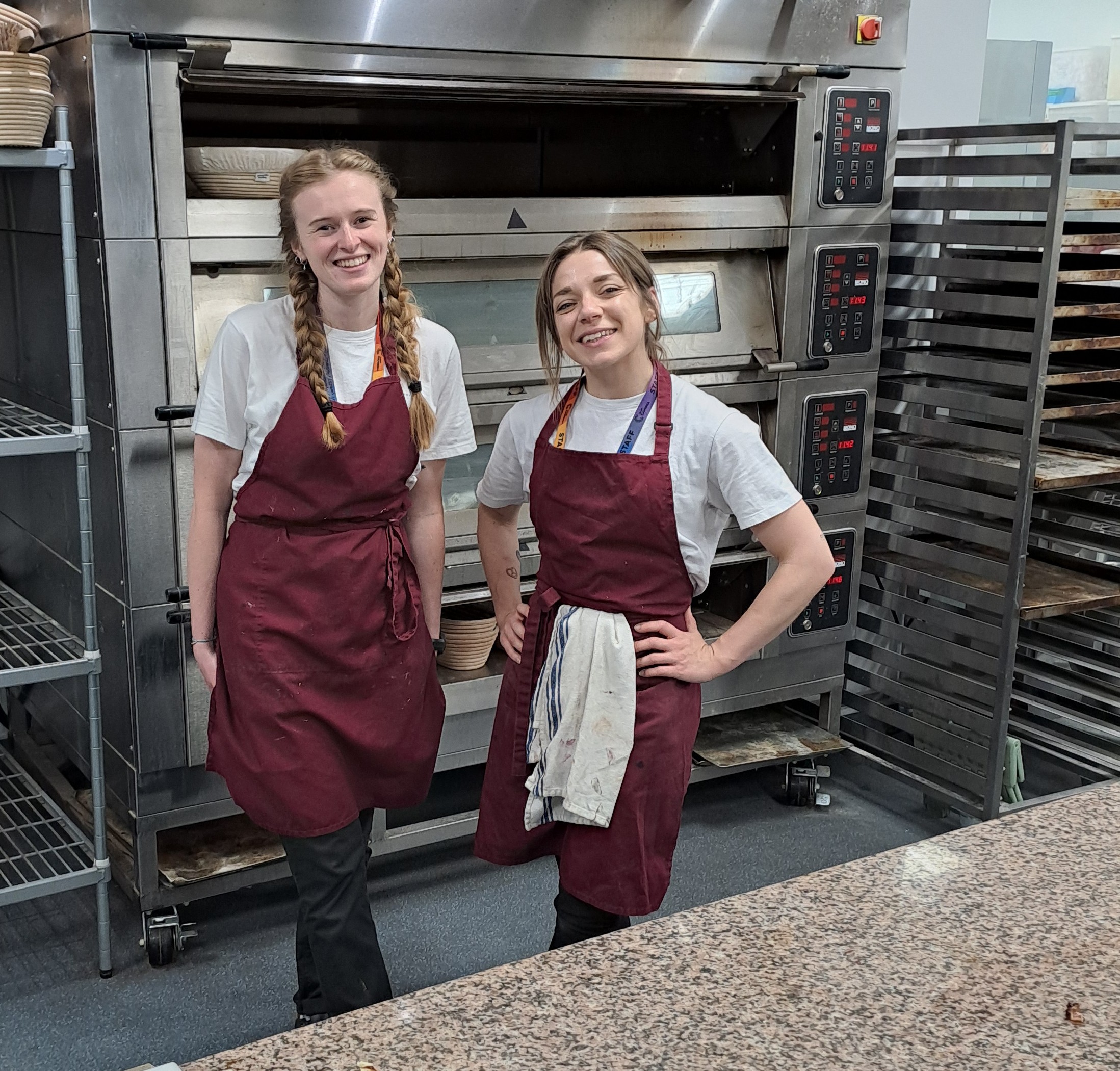
Students on the Level 3 Diploma in Baking Proficiency course, Naomi Spaven 29, and Ella Muddiman, 25, also both finalists in the BIA (Baking Industry Awards) Rising Star Awards, were given a live New Product Development (NPD) brief: to create both a sweet and a savoury festive product. 

Working in their college bakery, they brainstormed, tested, and refined a series of recipes before presenting them to BAKO and Wrights.

The pair then spent time at Wrights’ factory, learning how to adapt their bakery recipes into large-scale production. Cost, consistency, and capability all had to be factored in, giving them valuable experience of the realities of NPD in a commercial environment. They were also involved in the product photography, artwork, and sales presentations, gaining a full view of how a new product moves from idea to market.

Naomi Spaven, from Mold, said: “Taking part in this project has been such a brilliant experience, it’s completely different to the artisan baking I’d done before. Seeing how products are developed on such a huge scale has been mind-blowing, from watching the production lines in action to understanding the journey from concept through to completion, being able to see it all first-hand was fascinating.

“For me, one of the highlights was the creative side, decorating the cakes and experimenting with different toppings and flavours. It was amazing to see how each of us came up with something unique, and then to see the professional photography really bring those ideas to life. At the same time, I learned so much about the more technical side of baking, especially costings, and how to balance flavour with affordability. With things like cocoa prices rising so quickly, it was a real challenge to find ways of keeping products delicious while still being commercially viable.

“The whole project has broadened my view of the industry and shown me how many opportunities there are beyond day-to-day baking. I love the hands-on side of what I do, but this has also inspired me to think about teaching and passing on my passion to the next generation. I really want young people to see that there are so many different career paths in baking, from artisan bakeries to large-scale production and new product development. It’s made me even more certain that I’m in the right industry, and I feel really excited about the future.”

Nicola Goodwill, Senior Trading Manager at BAKO, said: “This is about more than launching three new festive lines. It’s about showing young people that their creativity has a place in this industry and that their ideas can go all the way to market. Naomi and Ella have been outstanding, and we hope this becomes the first of many Young Bakers projects, building an annual programme to inspire students across the UK.”

Ella Muddiman, 24, from Chester, described the experience as transformative: “I’ve loved every step of this project. At college, you usually bake something, and it ends there, but this gave me the chance to see the whole process. From brainstorming and trialling different flavours, to adapting the recipes at Wrights so they would actually work in production, it was a huge learning curve. The challenge of making something viable for scale, especially on cost, was tough but really rewarding. I especially enjoyed the flavour trials; experimenting with combinations and finding what worked best. To know that something I helped create will be on sale this Christmas is just incredible. It proves young bakers really can make a difference, and I hope it shows others that they can too.”

Anthony Choi, Senior Commercial Manager – Foodservice Wholesale at Wrights, said: “At Wrights, we’re passionate about inspiring the next generation of bakers, which is why we were delighted to partner with BAKO and Coleg Cambria on this exciting initiative.

“This project gave two talented students a unique and valuable opportunity to work with an expert team and chefs at a leading food manufacturer, experiencing the full NPD journey from concept and recipe development through to large-scale production.

“We were impressed by the creativity and fresh thinking they brought to the table. The reworked savoury Festive Slice was a smart seasonal upgrade, while the Black Forest Slice and Irish Coffee Slice filled a clear gap in the market and complemented BAKO’s existing range beautifully.

“It’s been a fantastic way to bring new ideas into the sector and showcase the potential of young talent. We’re proud to have played a part in helping future bakers shine, and we hope this project continues to inspire and open doors for the next generation.”

Naomi is the winner of the BIA Rising Star Award 2024 and runs the Little Welsh Foodie blog. Ella has just been shortlisted for the 2025 Rising Star Award and works at Iâl Bakery in Wrexham College.

Following the success of this pilot, BAKO plans to repeat the initiative annually. This year’s programme sets aside profits to support future young baker groups, building a sustainable pipeline of bakery talent for the industry.

GEO: The impact of AI on the role of earned PR for SMEs

If you have used Google recently, you will have experienced firsthand how AI has transformed the search experience. In search marketing, the widespread use of AI Summaries is altering how consumers find brands and prompting a reassessment of established digital strategies.

From SEO to GEO: the new rules of visibility

Search engine optimisation (SEO) has traditionally been used to increase online visibility. With the development of artificial intelligence, a new approach called Generative Engine Optimisation (GEO) is emerging. Instead of delivering lists of clickable links as search engines have previously done, AI-powered search tools now provide summaries based on information from various sources and may include generated perspectives.

This shift to zero-click search means users may never reach your website at all. Instead, the AI assistant is making up its mind about your brand by reading everything else that’s been written about you online, from news articles and customer reviews to industry blogs and analyst insights.

That’s where PR comes into its own.

Why PR matters more than ever

Public relations has consistently benefited traditional SEO, especially through effective link strategies. Before AI, Google’s algorithms already valued online brand buzz in rankings. GEO now amplifies this effect.

The performance of GEO depends on the way Large Language Models (LLMs) process and understand information. These models are typically trained to give preference to reliable third-party sources instead of web content that promotes an organisation. As a result, brands mentioned in editorial coverage from reputable sources are more likely to be recommended or referenced by AI systems.

As PRWeek noted in a recent celebratory headline, the PR industry is now “sitting on a goldmine”. Many aspects that GEO incentivises – such as earned media, authoritative features, and press releases – are traditionally part of public relations activities. Marketing teams that understand and embrace this can gain a serious competitive advantage.

And as one strategist put it in Entrepreneur: “That’s why editorial media coverage remains the most powerful tool in modern PR – and it matters now more than ever. There are two core elements here: high-quality editorial features and press releases.”

The key shift: authority beats ownership

Think of it this way: Google used to reward what you said about yourself. AI now rewards what others say about you. This fundamental change means PR is no longer just about visibility: it’s about measurable impact.

It’s also worth noting that AI isn’t just repeating facts. It’s curating and interpreting content, so if your brand isn’t appearing in authoritative, context-rich environments, you risk being left out of the conversation entirely.

So, what should we do?

In today’s landscape, earned media isn’t just influential – it’s essential for algorithms. PR and SEO must work together.

But, a word to the wise: public relations is not a quick fix or an easy “bolt on”. For something now so impactful in the digital world, PR remains a surprisingly human activity.

It’s not about pushing out content on autopilot. It’s about creating authentic, valuable stories that deserve coverage in trusted media – content that earns AI’s recognition while strengthening the human-facing credibility that PR is built on.

A key mantra is: if it works for a human, it will work for AI. Quality and authenticity are everything.

Lancaster man releases sleep science inspired children’s book

A Lancaster man has published a bedtime storybook based on the latest sleep science, with the aim of helping tired parents get young children off to sleep.

Greg Wilson, a public relations consultant based in Lancaster, was first inspired to write the book fifteen years ago while reading with his own young children at night. The idea came to him after noticing, when his children yawned, it should be the last book, as they were ready for sleep.

After reading a newspaper article that suggested that contagious yawning itself triggers sleepiness, he then developed The Biggest Yawn of All with Preston-based illustrator Kath Walker, as a fun way to encourage yawning at bedtime.

After shopping the book around a number of publishing agents, the feedback was that the original plan to end the book with a mirror would be too expensive a risk for a first time author with traditional publishing.

And so the project was shelved until this year, when Mr Wilson read a new article on the same subject that seemed to confirm the theory of contagious yawning being a cause rather than an effect of sleepiness, and decided to try publishing the book directly with Amazon.

He says: “I always really enjoyed reading to my own kids at bedtime but there was still a small sense of relief after three or four books when they would do a little yawn, which was a signal it was time to wind things up and put out the light.

“So, when I read that yawning – and contagious yawning in particular – actually works as a trigger for sleepiness, I wondered if that could be the basis for a fun book that could also work as a subtle sleep tonic for young children.

“After previously putting the idea on ice, I had almost forgotten about it until I read another article earlier this year about chimpanzees getting themselves ready for bed after picking up contagious yawns from a robo-chimp placed in their camp, confirming the theory that yawns actually make you sleepy.

“Amazon publishing wasn’t really a thing when we first developed the book, so I called Kath to check she was up for giving it a go publishing directly, this time with a different ending that is cheaper to print, but which still works as well, I think.

“We are initially targeting the UK and US markets with the English version of the book, and its success or failure is very much at the mercy of the Amazon algorithms.

“But if it takes off in those markets, the plan is to get it translated and try publishing it across the world, as a way of helping hardworking parents everywhere get their own little monkeys off to sleep at the end of the day.”

The Biggest Yawn of All is available from Amazon at https://amzn.eu/d/hQyfh7F.

Don’t let your comms go quiet this summer

As the UK summer makes its entrance (hopefully!), it’s easy for SMEs to fall into a content-holding pattern: light seasonal posts, a few sunny team updates, and not much else.

But here’s the thing: if you want your communications to work hard for your business, even during quieter months, you need a plan. Strategic communications don’t take time off, and neither should your brand visibility.

Why summer is a hidden opportunity for SMEs

While others wind down, you can stand out. Fewer updates on people’s feeds means there’s potentially less competition and more chance for your content to cut through. Whether you’re building trust, showcasing your expertise, or strengthening your brand, now is the time to show up with purpose.

Here are three ways you can do it:

1. Use summer themes that have substance

Community events, wellbeing initiatives, flexible working…these are perfect seasonal content ideas. But don’t stop at surface-level content. Make sure you tell stories that align with your values and show how your business makes a real impact.

2. Keep your messaging consistent and clear

Your audience might be in a more casual browsing mode, but that doesn’t mean they don’t notice quality. Every post should reflect your brand voice and purpose. Clarity and consistency win –  even in flip-flop season.

3. Lean into thought leadership while others stay quiet

Summer is a brilliant time to share insight. Fewer voices mean your perspective carries more weight. Share a fresh take on your industry, highlight what you’re learning, or reflect on your growth. Be the expert your audience remembers. Great PR isn’t just about being seen: it’s about being remembered for the right things.

If you’re tired of shouting into the void, we can help. Drop us a message here to find out how we create strategic, powerful communications that land – and last.

Hit or miss: what makes a story stand out in today’s crowded media landscape?

The online media landscape is becoming increasingly challenging to navigate – both for readers and for PR professionals trying to get their stories published.

At Limitless PR, our specialists focus on what makes a story stand out to journalists. With news platforms under pressure, they’re more selective than ever about the content they run. To cut through the noise, a story must grab attention, add value, and be truly irresistible to the media. That means crafting narratives that are timely, relevant, and backed by compelling insights. 

Four communications specialists from Limitless Public Relations explore what makes a story a PR hit – what grabs attention, adds value, and makes it irresistible to the media.

Greg Wilson - Strategic Communications - Limitless PR

Greg Wilson, director, said:

“Know your audience. Read the publications where you want to get the story published and make sure the story fits with their news agenda and format. Write the story as close as possible to the exact house style of your target media to make it as easy as possible for the journalist to pick it up. It should be possible for them to simply cut and paste the article if they want to. 

“Also, remember the power of photography. A great picture that brightens up the page will make the story much more attractive. Your photo should tell the story itself, as much as possible.”


Associate director Mark Sutcliffe emphasises the importance of asking the right questions when evaluating a story’s potential:

“A strong PR story answers key questions: What’s happening? Why is it important? Why now, especially for news-focused publications? What impact does it have on the wider community or sector, and what are the potential consequences? 

“Alongside this, providing a pre-digested, social media-friendly shareable – whether an image, video, or concise one-line summary – can make a story more appealing and easier for journalists to run with. In the past, this would have been called a standfirst, but today, it’s about creating content that is instantly engaging across multiple platforms.”


Justin Strong, associate director at Limitless, said:

“Keep it short and simple: tell the ‘story’ in the subject bar on your email, the headline of your press release, and the first three paragraphs. Everything after that, including quotes, supports and embellishes your key messages. 

“Never, ever start a quote with “We’re delighted…” It’s a statement of the bleedin’ obvious! And some publications won’t publish quotes that begin with this opening.”


Claire Stephenson - Limitless PR - Strategic Communications

Claire Stephenson, associate director at Limitless Public Relations, said:

“When crafting a press release, ask yourself: is it adding value or just adding to the noise? The world doesn’t need more content for the sake of it; it needs content that matters. Just because something is interesting to you doesn’t mean it will be newsworthy to a journalist! 

“To increase your chances of coverage, take the time to read the publication you’re pitching to and understand the topics the journalist actually covers. A well-targeted, relevant story stands a far better chance of making an impact than a generic pitch hurled into the void.”


Only the most compelling stories make an impact in a world overflowing with content. To cut through the noise, your narrative must not only grab attention but also add real value, making it impossible for the media to ignore. That’s where we come in. With a deep understanding of what drives engagement, we craft timely, relevant, and insight-led stories that get noticed. 

If you’re looking for extra power in your campaigns, contact us here for a chat. We’d love to help you take your communications to the next level. 

Trust plummets in government, businesses, and the rich

The 2025 Edelman Trust Barometer report reveals a troubling decline in public trust in businesses, fuelled by growing economic frustrations. 

The Edelman Trust Barometer is an annual global survey that measures public trust in government, business, media, and NGOs. It provides data-driven insights on trust trends, highlighting issues like transparency, ethics, and misinformation, to help organisations build credibility and address stakeholder expectations.

2025 Edelman Trust Barometer, page 17

According to this year’s report, which surveyed 33,000 people across 28 countries, six in ten respondents feel economically disadvantaged, and worryingly, some people believe hostile actions – even violence – may be necessary to create change.

The findings point to a deep sense of alienation, with many believing that both businesses and governments prioritise the wealthy over ordinary people. Younger generations are especially disillusioned, with over half of those aged 18 to 34 supporting the idea of taking drastic measures to force societal shifts.

For businesses, this is a wake-up call. The report highlights the need for companies to step up and actively rebuild trust. This means addressing economic inequalities by ensuring fair pay, investing in workforce training, and engaging with local communities. It also calls on businesses to be leaders in providing reliable information, promoting respectful dialogue, and challenging misinformation to help create a more connected and informed society.

Richard Edelman, the CEO of Edelman – a leading global public relations and marketing firm – said:

“The Edelman Trust Barometer 2025 finds a dissent into grievance. It’s been a progression from fears to polarisation. and now into grievance. [People feel that] there is a lack of quality information, a deep sense that the political system is broken, and lastly, a belief that, in fact, their family will not be better off in five years. 60% of respondents say that they’re aggrieved. They don’t believe the system is working. They feel pressed in terms of their bills. They actually find it difficult to navigate this world of misinformation, and they have no hope for the future.

“The question is, how to fix this? Trust has to be restored in order to do that. What does business do in this context? The default in the last couple of years has been, because business is so competent and ethical, let’s go to business. It’s a mistake to have business as the sole player here. Business is supposed to focus on things they can do really well –  skilling jobs with good pay, making sure that we have affordable products, but also sustainability. 

“But the other institutions have to step up. The government has to deliver on the matters to improve lives. NGOs are the healing force for the social fabric. And the media has to come back to the centre and give us facts we can rely on. If we can get to a place where there is optimism, it can overwhelm grievance, and then we can have a clear path to a belief in the future.”

From a PR perspective, the takeaway is clear: deeds, not words. Businesses must go beyond words and show real, measurable actions. Transparent communication, genuine community engagement, and a focus on societal impact will be crucial for restoring trust and addressing the growing divide.

Read more on the 2025 report and current trends here.

The power of clear communication: building trust in any business

Whether you’re running a large organisation, or a small business of just one person, clear, authentic communication is more crucial than ever. Building trust is the foundation of every relationship, and without it, even the best strategies can fall flat. 

In their 2024 Trust in Business Survey report, PwC found that:

  • 61% of consumers have recommended a company they trust to friends or family. 
  • Consumers also spend more at companies they trust — 46% purchased more, and 28% paid a premium. 
  • Four in 10 customers no longer purchase from a company due to lack of trust.

With public trust in institutions declining, improving and maintaining trust in business is at a premium.

Here are three essential ways to elevate your communication and build lasting trust with your audiences:

1. Be transparent  

Honesty always wins. When you’re upfront with your audiences, they feel more connected and secure in their relationship with you. Keeping communication open, even when the message is tough, shows your authenticity. It’s about telling the real story, no spin! Transparency invites trust by showing you’re willing to share the full picture, like the old Ronseal strapline: does exactly what it says on the tin.

 2. Practice active listening  

Great communication isn’t just about talking; it’s about listening. Responding thoughtfully to concerns or feedback demonstrates that you genuinely care about your audience’s needs. Listening and acknowledging others’ perspectives not only improves your relationship with them, but also builds long-term loyalty.

 3. Stay consistent  

Consistency is critical to building reliability. When your messaging is clear, cohesive, and steady across all channels, people know they can count on you. This reliability forms the backbone of trust, as your audience starts to see you as dependable, no matter the circumstances.

Building trust takes time and effort, but the payoff is definitely worth it. Need more advice on how to improve your strategic communications? We’re here to help! Drop us a message via the contact form or call 0845 625 0820.

How to improve your creative thinking in communications

Claire Stephenson takes a look at creativity and the crucial role it plays in effective communication and public relations campaigns.

Creativity is pretty much an essential skill in communications and public relations. You need it to create a buzz around a brand, structure a newsworthy story, connect strategy with actions, stakeholder management, turn bland content into something that has a spark, and social messaging that is both effective and garners interest…the list is long and wide.

What is creativity?

The Cambridge Dictionary defines creativity as the ability to produce or use original and unusual ideas. A brilliant book on the subject if you’re looking for inspiration – The Art of Creative Thinking by Rod Judkins – explores various strategies and techniques to enhance creativity. Through anecdotes, exercises, and examples from the lives of famous creatives, Judkins encourages readers to break free from conventional thinking patterns and embrace innovation. The book emphasises the importance of curiosity, risk-taking, and embracing doubt and failure as essential components of the creative process.

“Doubt is a key to unlocking new ideas. Einstein doubted Newton. Picasso doubted Michelangelo. Beethoven doubted Mozart.
That’s why they moved things forward.” 

Rod Judkins

Advertising great, John Hegarty – a founding partner of Bartle Bogle Hegarty (BBH) – talks about the environment in which creativity can flourish. He reflects on chaos versus process and the need to find the right balance for the individual. Hegarty at BBH came up with the glorious poster ad and strapline for a Levi Strauss black denim jeans campaign: “When the world zigs, zag.” The line aimed to reinforce the angle of standing out from the crowd, not being one of the flock.

The 1985 poster kick-started the TV ads (and the career of the late model and musician, Nick Kamen) and the infamous launderette scene where Kamen made the Levi 501s into a coveted item, boosting sales by 800%.

Levi’s – A Stitch In Time by BBH

But how do you ‘get creative’?

Several methods can help you shift your mindset towards a more creative slant. Here are three tried and tested methods (by us!) to improve your creative thinking.

1. Mind Mapping

This was a technique created by the late education consultant and author, Tony Buzan. Mind Mapping is an excellent method of visually organising information. Buzan first became aware of the concept during his studying years, when he noticed that his neat and ordered paragraphs of notes were time-heavy to produce, compared with other students who achieved higher grades but with less tidy notes. Buzan noticed his peers used colour and drawings within their notes. Researching through history, he discovered that notable figures of creativity and academia used drawings and doodles accompanied by words to examine theories, further research and break down concepts into easier-to-remember formats.

Mind Mapping is an excellent method if you’re a visual person and you like to doodle ideas and thoughts on paper. This short video by Tony Buzan on YouTube explains the basic concept behind Mind Mapping.

2. Brainstorm

This is a great technique for idea generation that can be done solo or on a team level. It’s also good for team cohesion and driving a project forward. Even brainstorming can be broken down into different methods. Here are 10 brainstorming techniques to try as an individual or a team. If you’re brainstorming within a group, it’s best to have a structure as the conversation can rapidly digress off-topic and swiftly turn unproductive. An article in Harvard Business Review offered the advice of focusing on asking better questions rather than seeking answers.

Keeping brainstorming fun and fresh is the key – try moving out of your usual environment. Take a brainstorming session on a walk or to the park for lunch, for example! Shaking it up can help produce the best atmosphere for ideas generation.

3. Exercise

This is one of the most effective idea-generation methods for many people. It can help to free up mental clutter and refocus thoughts, unleashing creative thinking. Steve Jobs was a notable figure who used walking to brainstorm ideas and help formulate strategies. He also carried out meetings with colleagues while he walked.

There is a scientific element to exercise and creativity. The release within the body of endorphin hormones during workouts is known to improve mood and produce the neurobiological ‘runner’s high‘ phenomenon. A study by Steinberg et al in 1997 recorded a 25% improvement in mood following physical exercise, but the results also demonstrated that exercise had a marked improvement in creativity levels. A 2014 study by Oppezzo et al found a positive correlation between exercise and creativity, stating that “walking opens up the free flow of ideas” and creative thinking processes.

These are just three ideas of ways to boost your creativity if you’re not feeling the buzz. But if you’re looking for some extra power to your campaigns, contact us here for a chat to see how we can help you.  

Hit your target: strategic communications done properly

From small businesses consisting of just one or two people, to large corporations of hundreds and thousands, there’s still a formula to follow that will ensure your communications have the desired direction and impact, meaning your messages hit the right target. If you’re creating a strategic communications strategy for the coming year, check out our advice here.

We asked four of our seasoned public relations and communications specialists for their top tips for strategic communications and the power of sharing a good story.

Power of Purpose

Greg Wilson - Strategic Communications - Limitless PR

Greg Wilson, on the benefits of authentic brand purpose:

“Having a true purpose is at the heart of any genuine brand story. And when you have an integral purpose, you have a great story to tell.

“Purpose includes an intrinsic set of values, that drives a business beyond increased annual profits or shareholder benefits.

“Let’s be clear about purpose and not let it become just another buzzword.”

Authentic storytelling

Claire Stephenson MCIPR, on genuine content and storytelling:

“Authentic storytelling can greatly impact your public relations efforts. Creating content that has a genuine purpose, but moreover, adds real value to your stakeholders/audience. Aim for this.

“People have had enough of cheap gimmicks and blatant sales pitches: they want fresh, honest and clever stories from brands they can trust.”

Claire Stephenson - Limitless PR - Strategic  Communications

Internal communications

Limitless Public Relations - Strategic Communications

Michael Gregory MCIPR FRSA, on internal communications:

“Don’t forget the importance and power of internal communications.

“If you’re embarking on a strategic communications campaign, let your people know first what’s happening in your organisation.

“Don’t let them find out what’s happening in the media.”

Quality of content

Mark Sutcliffe, on the quality of communications content:

“The first step to posting higher quality content is to step off the treadmill and refocus time and resources on creating high-quality content that’s relevant to the target audience to achieve what we, in the trade, call ‘cut-through’.

“Giving greater care and consideration to what you post in terms of its appeal, relevance, usefulness, originality, distinctiveness and creativity is likely to achieve greater ‘cut-through’ than wishing all your followers a ‘fab weekend’ or ‘happy Tuesday’.

“Setting the quality bar higher will inevitably reduce the volume of content an organisation is capable of creating. Social media platforms will continue to reward frequency, but genuinely engaged audiences will appreciate the improved quality of the information you share.”

Limitless Public Relations - Strategic Communications

As always, we are here to help if your business needs a powerful strategy to ensure that your audience(s) are kept informed and engaged in the best way possible, driving your business forward.

Message us here or call 0845 625 0820 to see how we can help your organisation be known.

Industry experts confirm AI is just a tool 

No, they weren’t name-calling. This was the rough summary, as interpreted by our Greg Wilson, of an event he attended last month (we’ve also discussed AI as threat or opportunity here).

AI Futures

The event, AI Futures: the Creative Industry in the North West was organised by ImaginationLancaster, Lancaster University and Wash Studio. Keynote speakers and panellists were drawn from across the worlds of academia, TV, film, music, architecture, design and marketing. 

Industry experts confirm AI is just a tool 

Here’s Greg’s take: 

Without regurgitating the whole speaker and panellist list for the full-day event, it’s hard to capture the credibility of the speaking panel, so hopefully, it’s suffice to say the organisers pulled together an extremely impressive array of senior and well-informed contributors. 

My key takeaways from the event were that, while AI is a genuine technical wonder that is developing fast, its outputs will only ever be as good as the human inputs it receives. And, more crucially for me in terms of its impact on the creative industries, it will never be able to judge the value of its own outputs from an emotional perspective. 

In short, to provide value, it will always need a human operator and/or “selector” at some level. Yes, it can produce imagery in seconds. But it will never experience an emotional response to that imagery, so will never know if it has done well, unless a human tells it so. 

Now, some people in the creative industries may say they know that feeling well! But, to me, the binary nature of AI means that it will only ever be a tool for people working in the creative industries. In that sense, it will only ever work for humans, and will never replace them… entirely. 

Entry-level at risk

There is huge weight in the word ‘entirely’ there though. The danger that AI poses, potentially, to the creative industries, is that it will be able to replace some of the entry-level creative roles where most of us got our start. 

I’m not sure, personally though, whether that is just part of natural change. I, for one, started my PR career in the late 90s, gluing photos to printed press releases, stapling them together, putting them in envelopes, slotting them through the franking machine then walking over to the red post box at the far end of the office estate to post them one by one – sometimes until it was too full to fit any more. 

And then they invented email. And then guess what?  

But people have still been getting entry-level jobs in PR since the 90s and long after I hung up my Pritt Stick. It’s just the nature of entry-level jobs that have changed, pretty much hand-in-hand with technological progress. 

At the moment, I feel that AI will, in fact, just help us do our jobs quicker, which means providing better value for clients. And the more value we can provide and quicker, the better shape the industry will be in, overall.